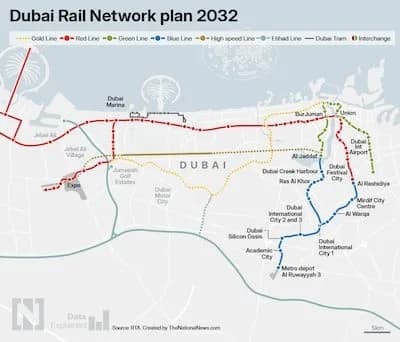
- Dubai has announced a AED 34 billion Metro Gold Line project
- The line will span 42 kilometres with 18 stations
- It will be Dubai’s first fully integrated underground metro route
- Expected completion date is 9 September 2032
- The project will serve around 1.5 million residents
- It will connect 15 key strategic areas across the city
- The line will integrate with Red Line, Green Line and Etihad Rail
- It is expected to support 55 major real estate developments
- The project is projected to deliver a 430 percent economic return over 20 years
Although the exact station locations are yet to be officially confirmed, the network plan released by the Dubai Media Office identifies the primary communities that are likely to benefit from the new line:
- · Bur Dubai
- · Al Ghubaiba
- · Dubai Maritime City
- · Port Rashid
- · City Walk
- · Jumeirah
- · Satwa
- · Zabeel
- · Business Bay
- · MBR City
- · Al Merkadh
- · Meydan
- · Ras Al Khor
- · Dubai Hills
- · Al Barsha South
- · JVT & JVC
- · Dubai Sports City
- · Hadeq Mohammed Bin Rashid
- · Dubai Production City
- · Dubai Studio City
- · Tilal Al Ghaf
- · Wadi Al Safa
- · Al Barari
- · Jumeirah Golf Estates
- · Arabian Ranches
Dubai’s AED 34 Billion Gold Line: The Infrastructure Move That Will Decide the Next Property Hotspots
What if I told you that Dubai has just quietly drawn a map of where property prices are most likely to rise over the next decade?
Not through speculation. Not through marketing.
Through infrastructure.
The newly announced Dubai Metro Gold Line is not just another transport project. It is a AED 34 billion signal of intent. And if you are an overseas investor trying to understand where the next wave of growth comes from, this is the kind of move you pay attention to early.
Because in Dubai, infrastructure does not follow growth. It creates it.
A Project That Changes the Shape of the City
Let’s start with the facts.
Dubai is building a 42 kilometre fully underground metro line with 18 stations connecting 15 strategic districts across the city
Completion is targeted for 9 September 2032. That date is not random. It aligns with long term planning tied to Dubai’s 2040 Urban Master Plan.
This line will connect:
- Historic districts like Bur Dubai and Al Ghubaiba
- Established hubs like Business Bay and Jumeirah
- Growth corridors like Meydan and MBR City
- Residential communities such as JVC, JVT and Dubai Hills
- Lifestyle destinations, including Tilal Al Ghaf and Arabian Ranches
It also integrates directly with the Red Line, Green Line and Etihad Rail, effectively linking local, regional and national transport networks into one system.
That matters more than it sounds.
Because connectivity is not just about convenience. It is about economic gravity.
Why Infrastructure Drives Property Prices
Here’s the part most people miss.
When a metro line is announced, the opportunity is not at completion. It is in the years before.
The data is consistent. Properties near metro stations in Dubai have historically outperformed wider market averages. This new line is expected to push values near stations up by as much as 20 percent.
But that headline number is only part of the story.
What really happens is this:
- Accessibility improves
- Demand broadens from both tenants and buyers
- Rental yields stabilise or increase
- Exit liquidity improves
In simple terms, more people want to live there, more people can afford to live there, and more people are willing to buy from you later.
That combination is what serious investors look for.
The 55 Developments That Just Became More Relevant
The Gold Line will support 55 major real estate developments currently in progress
Now think about that.
Developments that were already planned are now being plugged into a future transport backbone.
This is where strategy comes in.
Not every property along the route will perform equally. The winners tend to be:
- Walking distance to stations
- Strong developer track record
- Sensible entry pricing
- Real end user demand
Areas like Meydan, MBR City, Dubai Hills, and JVC stand out immediately.
You already have population growth, infrastructure investment, and job creation feeding into these areas. The metro simply accelerates what is already happening.
A Quiet Shift Towards Underground Infrastructure
One detail that deserves more attention is this being Dubai’s first fully integrated underground metro line
That tells you something about the maturity of the city.
Underground transport is more expensive, more complex, and typically reserved for dense urban centres where land value is high and disruption needs to be minimised.
In other words, Dubai is doubling down on long term urban density in key districts.
For investors, that translates into stronger fundamentals.
Not speculation. Not hype.
Real urban demand.
The Etihad Rail Factor
Now let’s add another layer.
The Gold Line connects with Etihad Rail at Meydan and Jumeirah Golf Estates.
That is not just a Dubai story anymore.
That is UAE wide connectivity.
Imagine a tenant or buyer who can move seamlessly between emirates for work, lifestyle, or business.
That expands your tenant pool.
It increases the long term relevance of the location.
And it strengthens the case for holding rather than flipping.
What This Means for Overseas Investors
If you are sitting outside the UAE, this is where it becomes practical.
Dubai continues to do three things exceptionally well:
- Build infrastructure ahead of demand
- Align it with long term population growth
- Link it directly to real estate development
That combination is rare.
Now layer on top:
- No income tax
- Strong rental yields
- Clear ownership laws
- Residency options through property investment
And you start to see why capital keeps flowing in.
The Gold Line simply reinforces that story.
It is another piece of evidence that Dubai is not slowing down. It is scaling up.
Timing the Opportunity
Here’s where I will give you a slightly more direct view.
The best time to invest around infrastructure is not when it is complete.
It is when:
- The route is confirmed
- The areas are identified
- The wider market is still debating the impact
We are at that stage now.
There will be a period where prices start to adjust slowly. Then faster. Then the opportunity tightens.
That pattern has repeated itself across previous metro expansions.
Where I Would Be Looking Right Now
If I were positioning capital today based on this announcement, I would focus on:
- Meydan and MBR City for long term growth
- JVC and JVT for yield plus accessibility upside
- Dubai Hills for established demand with added connectivity
- Jumeirah Golf Estates for premium positioning with rail integration
But the key is not just picking an area.
It is picking the right project within that area.
That is where most investors get it wrong.
A Word of Caution
Not everything along a metro line becomes a great investment.
Some projects will be overpriced simply because they are near a station.
Others will lack real demand once you strip away the marketing.
So the approach needs to be selective.
You are not buying the metro.
You are buying the fundamentals of the property, with the metro as an added advantage.
Final Thought
Dubai has just mapped out its next decade of movement, growth, and connectivity.
The Gold Line is not just about getting from A to B.
It is about linking where people live, where they work, and where capital flows.
And when those three align, property tends to follow.
If you are looking at Dubai from the outside, this is one of those moments where it makes sense to step in early, not late.
Next Step
If you want a clear view on which specific projects along this route actually make sense, and which ones to avoid, it is worth having a proper conversation.
Not a sales pitch. A strategy discussion based on your position, timeline, and risk appetite.