- Dubai is now ranked 7th globally in the Global Financial Centres Index
- This is the highest ranking ever achieved by a financial hub in the region
- Dubai climbed four places in just six months
- The index evaluates 137 global financial centres
- More than 34000 financial professionals contributed to the ranking
- Dubai aims to become a top four global financial centre by 2033
- DIFC is a central driver of this growth and expansionDIFC recorded 1924 new companies in a single year
- Total companies in DIFC now exceed 8800 with over 50000 professionals
- Dubai is ranked the number one financial centre expected to gain further importance
What happens when a city that was not even in the top 20 a few years ago suddenly breaks into the global top 7 financial hubs?
You do not just get headlines. You get capital movement. You get a business relocation. And more importantly, you get long-term demand for real estate.
Dubai’s latest ranking in the Global Financial Centres Index is not just a milestone. It is a signal. And for investors sitting outside the UAE trying to make sense of the noise, this is one of the clearest indicators of where the market is actually heading.
Let’s break it down properly.
From Emerging Market to Global Financial Player
Dubai is now ranked seventh globally in the Global Financial Centres Index, placing it alongside cities like London, New York and Singapore.
That is not marketing spin. That is a measurable shift in global positioning.
Just a few years ago, Dubai was ranked 22nd. Now it sits firmly in the top 10, and importantly, it is the highest ranked financial centre across the Middle East, Africa and South Asia.
That kind of movement does not happen by accident.
It is the result of a very deliberate strategy, backed by regulation, infrastructure and capital inflows.
Why This Matters for Property Investors
Here is the thing most people miss.
Financial hubs drive property markets.
Not speculation. Not hype. Not social media noise.
Real businesses. Real jobs. Real people relocating.
When a city becomes a global financial centre, three things happen:
First, international firms move in
Second, talent follows those firms
Third, demand for housing increases across multiple segments
Dubai is ticking all three boxes.
And this is where overseas investors need to pay attention.
Because by the time this trend becomes obvious to everyone, pricing has already moved.
DIFC The Engine Behind the Growth
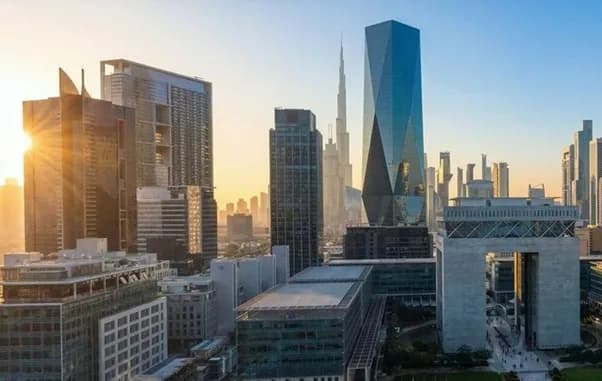
At the centre of this growth story is the Dubai International Financial Centre.
DIFC is no longer just a financial free zone. It is becoming one of the most important financial ecosystems globally.
In the last year alone:
1924 new companies were registered
Total active companies reached over 8800
More than 50000 professionals are now based there
That is not incremental growth. That is acceleration.
And it does not stop there.
Dubai has already committed to a major expansion through the DIFC Zabeel District, with plans to accommodate up to 42000 companies and 125000 professionals.
Think about that for a second.
That is effectively building a new financial city within Dubai.
And every one of those professionals needs somewhere to live.
The Bigger Picture The D33 Agenda
This ranking is not an isolated win. It sits within a much larger strategy.
Dubai’s Economic Agenda D33 aims to double the size of the economy to AED 32 trillion over the next decade.
The goal is clear.
Become one of the top four financial centres globally by 2033.
Now, you can take that as ambition. Or you can take it as direction.
Because when Dubai sets targets like this, it tends to build the infrastructure first and let demand follow.
We have seen this playbook before.
Infrastructure leads. Demand follows. Prices adjust.
What Overseas Investors Should Really Be Looking At
If you are based in the UK, Europe or Asia, you are likely seeing mixed messages about Dubai right now.
Some headlines talk about uncertainty. Others talk about opportunity.
Both can be true at the same time.
But here is the filter you should use.
Ignore short term sentiment
Focus on long term fundamentals
And the fundamentals right now are clear:
Global ranking improving
Financial sector expanding
International companies relocating
Population growth continuing
Infrastructure investment increasing
This is not a market built on speculation anymore.
It is a market built on economic positioning.
Financial Growth Translates Into Real Estate Demand
Let’s make this practical.
When a financial centre grows, it does not just impact office space.
It impacts:
Rental demand
Property values
Tenant quality
Liquidity in the resale market
Areas with strong connectivity to financial hubs tend to benefit first.
Then secondary areas follow as affordability becomes a factor.
This is where strategy matters.
Not every property will benefit equally.
But the right assets in the right locations tend to outperform over time.
Residency, Lifestyle and Capital Movement
There is another layer to this that often gets overlooked.
Dubai is not just attracting companies.
It is attracting individuals.
High net worth individuals, entrepreneurs and professionals are choosing Dubai for a combination of reasons:
Tax efficiency
Global connectivity
Lifestyle quality
Political stability
Business friendly regulation
This is creating a very different type of demand compared to previous cycles.
More end users. More long term residents. More stability.
And that changes how the property market behaves.
A Reality Check on Market Noise
Now let’s address the elephant in the room.
Yes, the market feels quieter right now.
Yes, there is hesitation.
That is normal.
Sentiment always reacts faster than fundamentals.
But here is the key point.
The data that feeds into this global ranking was compiled before recent regional tensions.
So what you are seeing now is a short term emotional response layered on top of a long term structural shift.
Those are two very different things.
So Where Does This Leave You as an Investor
You have two options.
Sit on the sidelines waiting for absolute clarity
Or start identifying opportunities while others hesitate
There is no perfect entry point.
There never is.
But markets like this reward those who understand timing is not about guessing the bottom.
It is about recognising direction.
And right now, Dubai’s direction is very clear.
A Thought to Leave You With
If Dubai was already ranked 7th globally today, and is actively targeting a top four position by 2033…
What do you think happens to demand, pricing and global attention over the next decade?
That is the question worth thinking about.
Why Speak to Steven Leckie
If you are looking at Dubai from overseas, the challenge is not access.
It is clarity.
Knowing which opportunities actually make sense for your goals, your timeline and your risk profile.
That is where experience matters.
Steven Leckie has been in Dubai since 2003, working through multiple market cycles and advising international investors on how to position themselves correctly in both rising and uncertain markets.
If you are serious about investing, the first step is not choosing a property.
It is having the right conversation.